Table of Contents
- 1. Understanding the Enterprise AI Landscape
- 2. The Core Difference: In-House AI vs. AI Partner
- 3. When Should Enterprises Consider Building AI In-House?
- 4. Challenges of Building In-House AI
- 5. When Should Enterprises Choose an AI Partner?
- 6. Challenges of AI Partnerships
- 7. Key Factors Enterprises Must Evaluate
- 8. Hybrid Approach: The Perfect Middle Path
- 9. Real Enterprise Use Cases: Build vs Partner
- 10. Common Mistakes Enterprises Make
- 11. Practical Steps to Make the Right Decision
- 12. Conclusion
Artificial Intelligence is no longer an optional upgrade — it is the backbone of enterprise digital transformation. From customer service to supply chain operations, AI is driving accuracy, speed, personalisation, and automation at levels previously impossible.
But as AI adoption grows, enterprises face one major strategic decision:
Should we build AI systems in-house or partner with an experienced AI provider?
This question goes beyond tools — it impacts cost, scalability, competitive advantage, security, innovation speed, and company culture.
Below is an expanded, deeply detailed version of your original article, with every point and section enhanced.
Understanding the Enterprise AI Landscape
Enterprises are no longer exploring AI just for innovation — they are adopting it to survive in a competitive, fast-changing market. AI has entered operational, customer-facing, and strategic layers of business.
Today, enterprises rely on AI for:
-
Automation: Reducing human errors, cutting costs, and streamlining processes
-
Predictive analytics: Identifying trends and forecasting future behaviour
-
Customer experience: Chatbots, AI agents, personalised journeys
-
Decision-making: Insights-driven strategies based on real-time data
-
Security & fraud detection: Monitoring anomalies at a large scale
-
Generative AI: Enabling content creation, software development, research, and much more
But AI adoption is not plug-and-play. Enterprises must build:
-
Strong data pipelines
-
Modern infrastructure
-
Trained personnel
-
Compliance frameworks
-
Change management practices
This is why the build-vs-partner decision becomes significant.

The Core Difference: In-House AI vs. AI Partner
Building In-House Means:
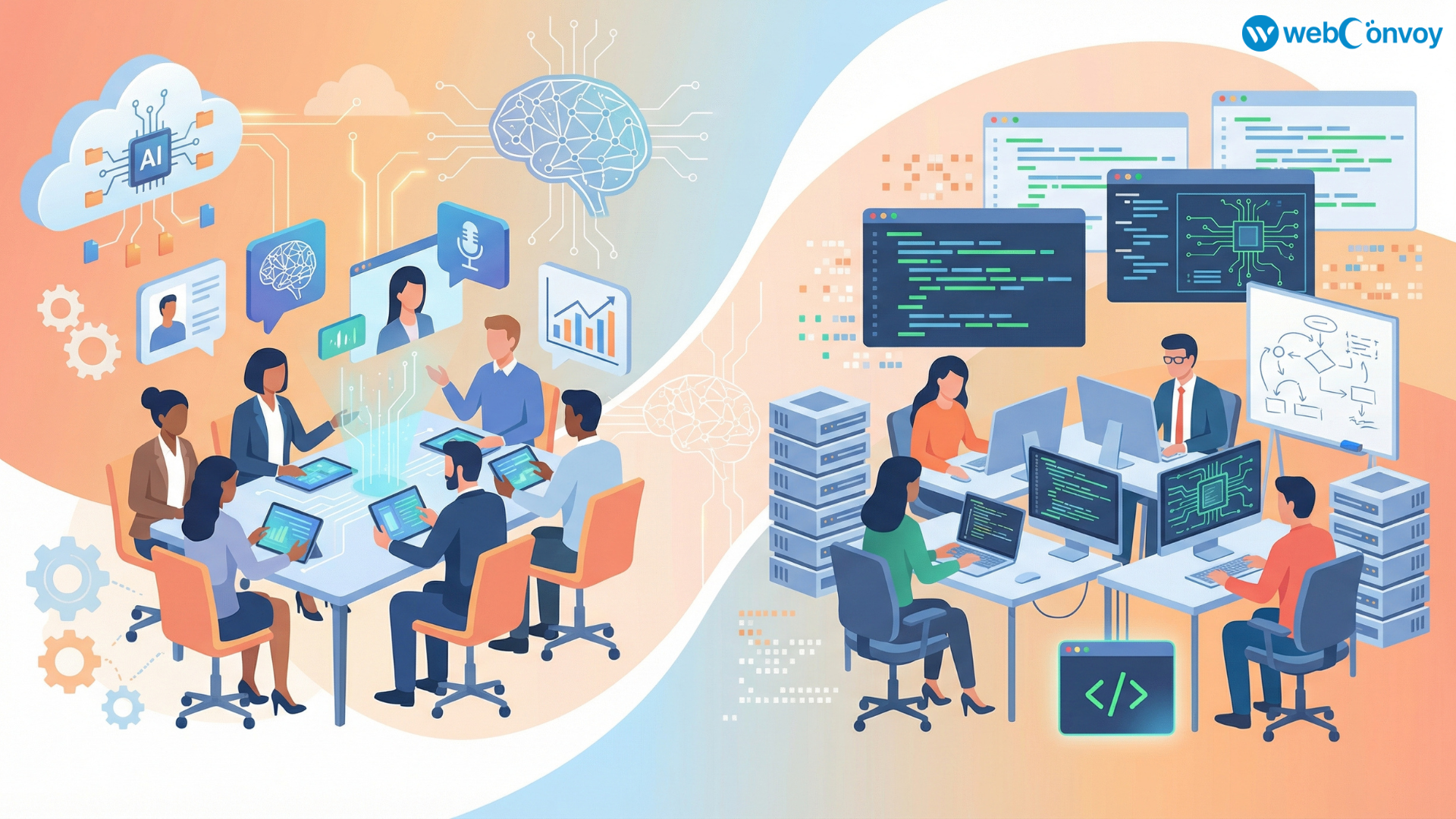
Your organisation develops, trains, manages, and deploys AI systems internally using your own engineers, data scientists, architects, and tools.
Partnering Means:
You collaborate with a third-party AI company that has ready-made frameworks, trained teams, tools, and expertise to plan, build, deploy, and maintain your AI system.
Both routes have value — but the right choice depends on your goals, industry, budget, and plans.
When Should Enterprises Consider Building AI In-House?
Building in-house is a strong option when your enterprise wants full control, strategic ownership, and proprietary capabilities.
1. Full Control and Customisation
You can design the entire AI system exactly the way you want —
-
tailored workflows
-
customized models
-
proprietary algorithms
-
industry-specific business logic
This is valuable in industries like e-commerce, FinTech, cybersecurity, and healthcare, where differentiation and precision matter.
2. Long-Term Cost Efficiency
Initial investment is high, but over time, you reduce:
-
subscription fees
-
dependency costs
-
vendor markups
For enterprises with long-term AI roadmaps, this becomes a cost-effective approach.
3. Proprietary Competitive Advantage
When you develop your own AI systems, you:
-
own the technology
-
own the data pipeline
-
own the IP
-
build unique capabilities that competitors cannot access
This creates lasting differentiation.
4. Stronger Data Security
Some industries (banks, government orgs, insurance, hospitals) cannot expose sensitive data to third parties.
In-house development allows complete control over:
-
data flow
-
encryption
-
storage
-
governance
5. Faster Experimentation
Internal teams can:
-
test new ideas
-
launch pilot projects
-
iterate quickly
-
innovate without vendor dependence
This accelerates product evolution.
Challenges of Building In-House AI
While powerful, building AI internally requires significant investment and planning.
1. Talent Shortage & High Costs
AI specialists are expensive. You need:
-
Data Scientists
-
ML Engineers
-
AI Architects
-
DevOps Engineers
-
Data Engineers
-
Product Managers
Hiring, training, and retaining them is extremely costly.
2. Infrastructure Demands
AI requires:
-
GPUs / TPUs
-
cloud compute
-
model training environments
-
real-time pipelines
-
scalable storage
-
MLOps platforms
This infrastructure is expensive to build and maintain.
3. Long Time-to-Value
The average enterprise AI project takes:
-
6 to 12 months for setup
-
12 to 24 months for actual results
This delay can cause competitive lag.
4. Difficulty Scaling
As your business grows, your AI system must handle:
-
larger datasets
-
more users
-
new features
-
real-time processing
Scaling in-house models is a major technical challenge.
5. Risk of Slow Innovation
If the internal team cannot keep up with global AI advancements, your system may become outdated.
When Should Enterprises Choose an AI Partner?
Working with an external AI partner is ideal when enterprises want faster results with minimal risk.
1. Rapid Deployment
AI partners bring:
-
pre-built models
-
ready frameworks
-
industry-specific blueprints
-
experienced teams
This reduces implementation time from months to weeks.
2. Access to Top Experts
Instead of hiring expensive specialists, you instantly get:
-
ML engineers
-
AI researchers
-
domain experts
-
data scientists
-
cloud specialists
They already know what works and what doesn't.
3. Lower Upfront Costs
No need to invest in:
-
GPUs
-
R&D teams
-
MLOps infrastructure
-
large engineering teams
Your budget becomes predictable and manageable.
4. Scalable Architecture
AI partners typically give:
-
managed platforms
-
cloud-native solutions
-
auto-scaling systems
-
maintenance & updates
This ensures long-term stability.
5. Continuous Innovation
Partners stay updated with:
-
new AI models
-
generative AI advancements
-
cloud improvements
-
industry best practices
Your system evolves automatically.
Challenges of AI Partnerships
Partnering also comes with its own challenges.
1. Vendor Lock-In
If architecture is proprietary, switching becomes painful and expensive.
2. Limited Deep Customisation
Some partners restrict low-level custom modifications.
3. Data-Sharing Concerns
Not all enterprises want third-party involvement in sensitive data processing.
4. Recurring Costs
Subscription fees may rise as usage increases.
Key Factors Enterprises Must Evaluate
When deciding between building in-house and partnering, enterprises should analyse these 10 detailed factors:
1. Budget Capacity
Can you invest millions in infrastructure, staff, and training?
2. AI Deployment Timeline
Do you need results now, or can you wait 1–2 years?
3. Data Security Requirements
Is your data too sensitive for outsourcing?
4. Organisational AI Maturity
Do you already have analytics teams, or are you starting from scratch?
5. Strategic Importance of AI
Is AI part of your core product or just an enhancement?
6. Scalability Expectations
Will you need multi-department adoption over time?
7. Innovation Requirements
Do you need cutting-edge R&D?
8. Long-Term Cost Implications
Calculate:
-
Build TCO
-
Partner TCO
9. Regulatory Compliance
Industries like BFSI and healthcare require strict rules.
10. Talent Availability
Do you have the ability to attract top talent?
Hybrid Approach: The Perfect Middle Path
Many enterprises are now choosing a hybrid AI strategy because it offers both speed and long-term independence.
The hybrid approach includes:
1. Partnering first to build fast
Let experts set up the AI ecosystem:
-
models
-
pipelines
-
infrastructure
-
dashboards
2. Training your internal teams gradually
Partners help your teams learn:
-
MLOps
-
model tuning
-
AI maintenance
-
data governance
3. Taking ownership in the long run
Once your in-house team is confident, you slowly:
-
migrate
-
optimize
-
expand
-
innovate
This minimises risk and accelerates success.
Real Enterprise Use Cases: Build vs Partner
Use Case 1: Banking & Finance – Mostly Partner
Reasons:
-
heavy regulations
-
zero-tolerance for errors
-
advanced fraud systems required
-
need for certified tools
Banks prefer reliability and compliance over customisation.
Use Case 2: E-commerce – Mostly Built In-House
Reasons:
-
personalization models
-
search relevance
-
recommendation engines
-
customer behaviour analysis
E-commerce giants need full control over user data and customisation.
Use Case 3: Manufacturing – Hybrid
Reasons:
-
IoT + analytics + automation
-
need for real-time data
-
robotics AI integration
Partners help with setup; internal teams handle operations.
Use Case 4: Healthcare – Mostly Partner
Reasons:
-
privacy laws
-
certified AI models
-
clinical accuracy
-
compliance frameworks
Healthcare requires specialised, validated AI partners.
Common Mistakes Enterprises Make
1. Treating AI as a one-time project
AI is a continuous capability that requires constant improvement.
2. Poor Data Quality
AI fails without clean, structured data.
3. Overestimating In-House Capabilities
Enterprises often underestimate:
-
training effort
-
maintenance
-
complexity
4. Choosing Cheaper Vendors
Cheap vendors often lack:
-
security
-
scalability
-
reliability
5. Ignoring Change Management
Employees must be trained, supported, and guided to adopt AI.
Practical Steps to Make the Right Decision
Step 1: Assess Your AI Readiness
Evaluate:
-
tech infrastructure
-
current workflows
-
team skills
Step 2: Define AI Use Cases
Align AI with business goals:
-
improve customer support
-
automate manual tasks
-
reduce costs
-
boost product intelligence
Step 3: Compare TCO (Total Cost of Ownership)
Include:
-
hiring
-
training
-
hardware
-
cloud costs
-
vendor fees
-
maintenance
Step 4: Run Pilot Experiments
Execute one pilot internally and one with a partner. Compare:
-
ROI
-
deployment speed
-
quality
-
scalability
Step 5: Define Your Long-Term Path
Choose:
-
full in-house
-
full partner
-
hybrid strategy
This ensures clarity and consistent execution.
Conclusion
There is no universal answer to the build-vs-partner debate. The right choice depends on your enterprise’s:
-
data maturity
-
available budget
-
urgency
-
industry regulations
-
long-term AI strategy
- If speed, low risk, and fast ROI matter — partner with an AI company.
- If ownership, deep customisation, and data control matter — build in-house.
- If you want the best of both, choose a hybrid model.
Enterprises that take a thoughtful, structured approach will harness AI’s full potential and stay ahead in the coming era of intelligent business transformation.
Related Posts